
Studies
How is World Cup access shared among confederations, and where does CONMEBOL stand?
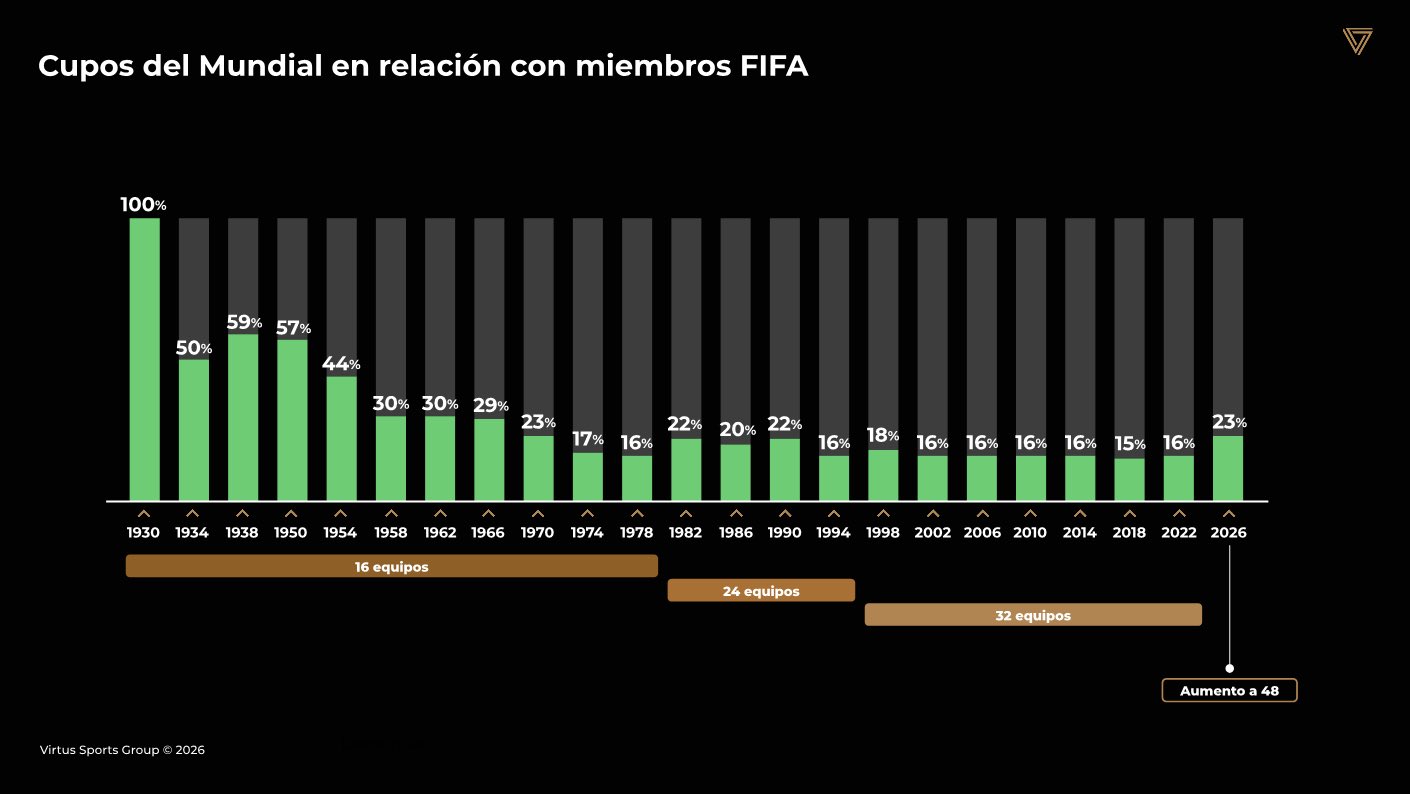
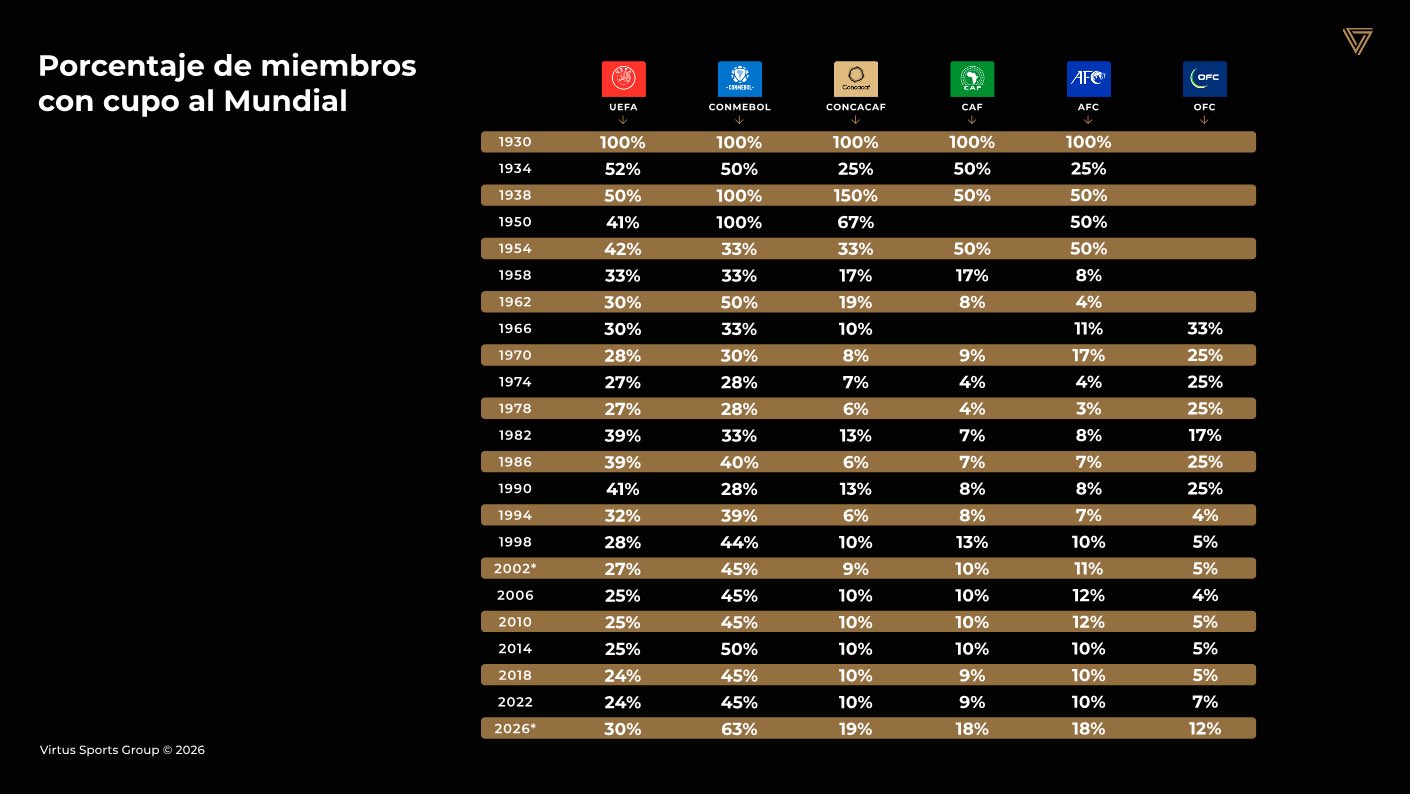
With the 48-team World Cup, 23% of FIFA members have a place, up from 16% in 2022. CONMEBOL has 63% of its associations with a slot, the highest share of any confederation.
Virtus Sports Group ·
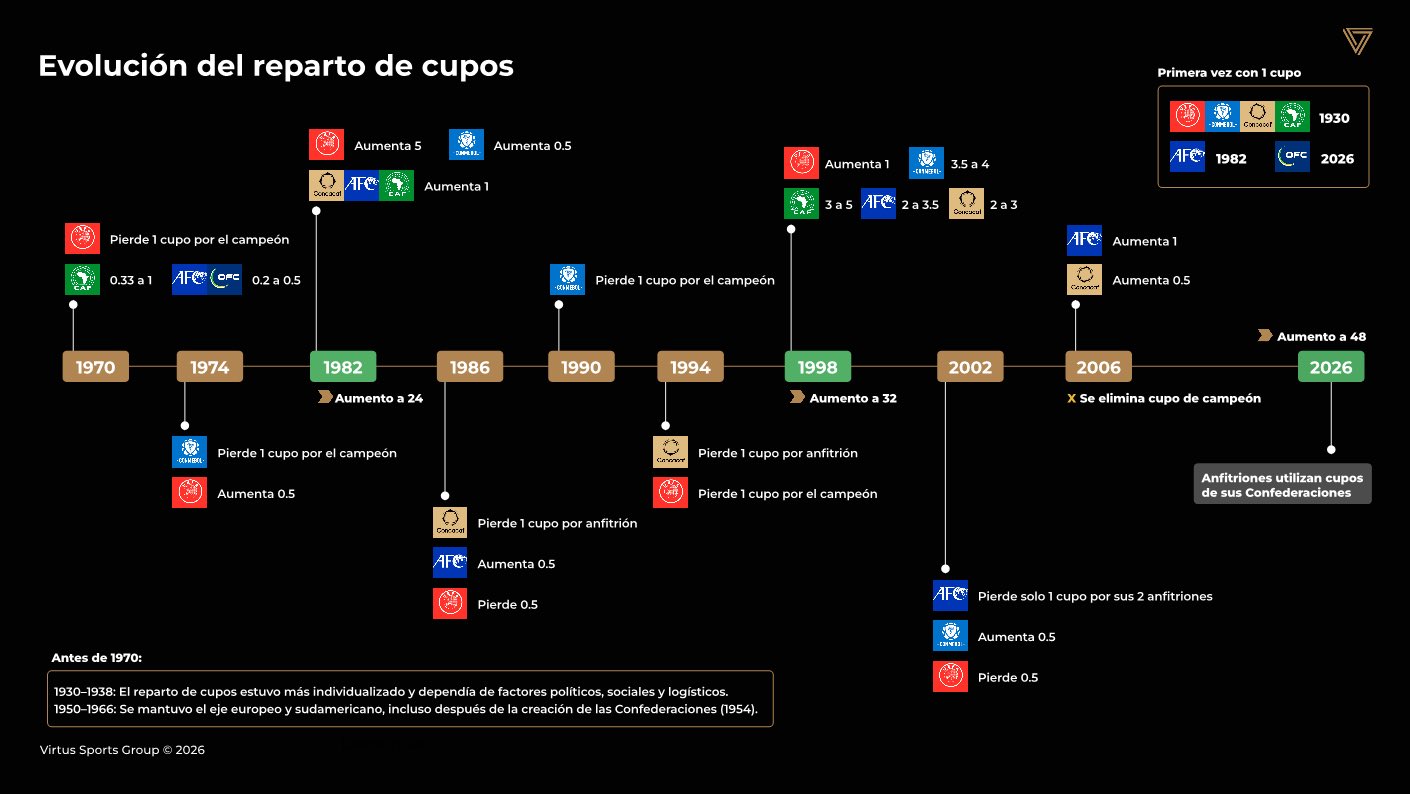
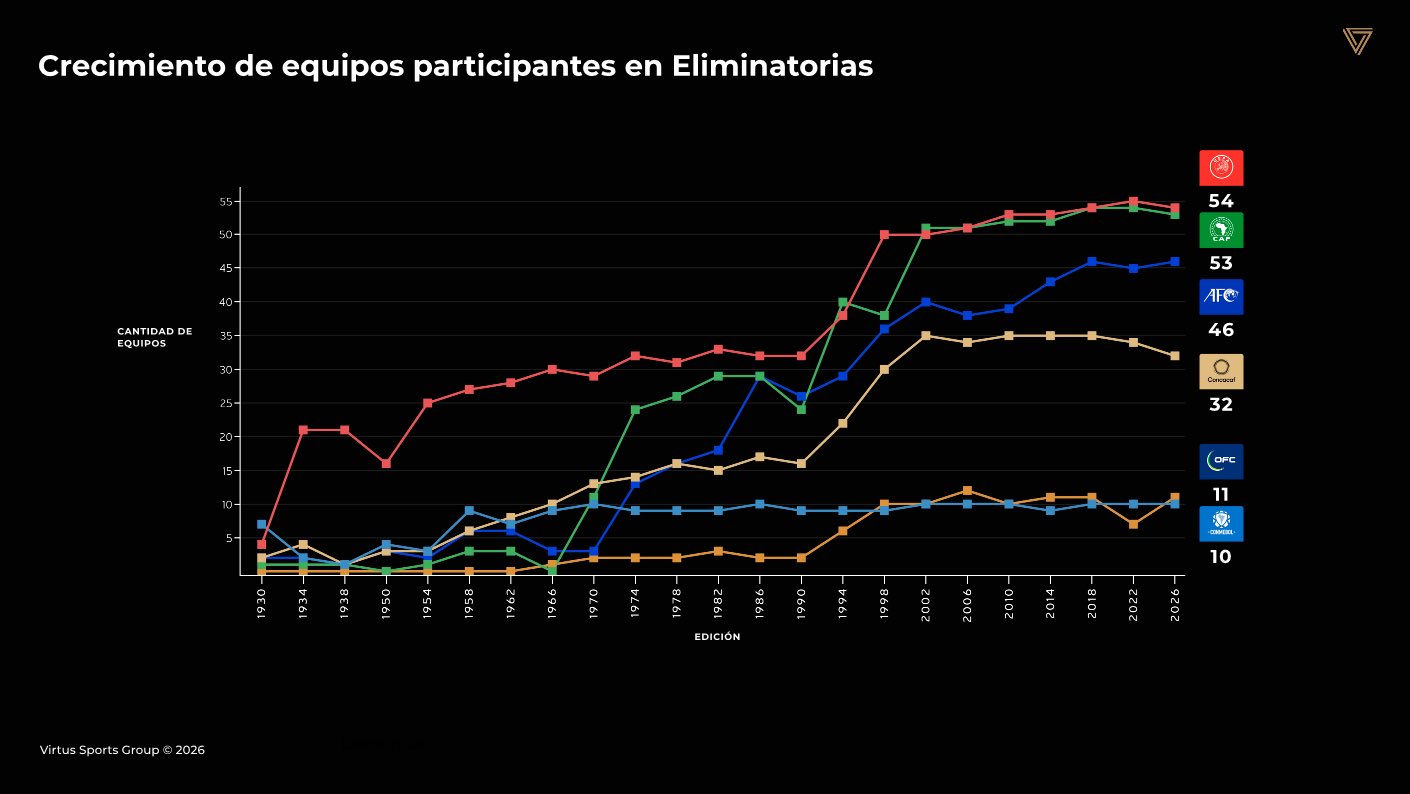
Access to the World Cup is not only a matter of how many slots each confederation receives. It is also a matter of what share of each confederation’s members reach the tournament, and of how many teams enter qualifying. This four-panel series traces that evolution from 1970 to the 48-team World Cup.
The first panel follows slot changes by confederation: increases, losses linked to the champion or the host, and the jumps to 24, 32 and 48 teams. A note states that between 1950 and 1966 “the European and South American axis was maintained, even after the confederations were created (1954).” It also notes that hosts use slots from their own confederations.
The second panel shows the growth of teams in World Cup qualifying. In 2026, UEFA has 54, CAF 53, AFC 46, CONCACAF 32, OFC 11 and CONMEBOL 10. South America has fewer participants because the confederation has ten members; almost all of them enter the process.
The third panel sets slots against FIFA membership. In 2022, 16% of members had a place. In 2026, with the expansion to 48, that share rises to 23%. It remains well below the 16-team editions, when the percentage was much higher, but it is the widest relative access in several decades.
The fourth panel is the most direct reading for CONMEBOL. In 2026, 63% of its members have a World Cup slot, compared with 30% for UEFA, 19% for CONCACAF and 18% for both CAF and AFC. OFC stands at 12%. In 2022, CONMEBOL was at 45% and UEFA at 24%. The expanded World Cup raises coverage inside South America more than in Europe, where there are far more member associations.
For the management of South American football, the figure cuts two ways. The region keeps the highest internal probability of being at the Cup: in the 2026 cut, six in ten associations have a slot. That coverage, however, does not mean more teams in qualifying or a looser calendar. The format is still that of a small confederation in membership, with high competitive density. Access design, preparation for national teams that now reach the tournament more often, and comparisons with Europe should not be read only as a raw slot total, but as what those slots represent for each association.
Infographic: Jaime F. Macías / Virtus Sports Group
Back to Studies